Topic: Euro
I- How did Euro break or enforce boundaries and facilitate movements of people?
1) Do the people of the Euro zone move freely inside the zone?
2) Do they also move freely outside the euro zone?
3)What about the people outside the Euro zone? How difficult is it for them to get in?
II- What is the influence of Euro on international trade?
1) What is the importance of Euro as an international currency?
2) Is there free trade inside the Euro zone?
3) What are the policies of movements of goods (and money) from the euro zone to other places?
III- Did Euro bring standards inside its zone?
1)What are these standards for being part of the Euro currency zone?
2)Is education following the same standards everywhere in the Euro zone?
3) What were the reasons for the creation of the Euro currency?
Monday, December 1, 2008

Wednesday, November 12, 2008
World Bank: Alpha and Youssouf
Started in Bretton Woods during WWII as part of the UN, the World Bank’s first purpose was to help rebuild Europe in post WWII. Its first loan of $250 million in 1947, was to France. The Bank’s objectives have changed today, to a sharp focus on poverty reduction. The Bank has been a financial (in lending) and technical support to many underdeveloped nations in Africa, Asia and Latin America. During the 1980s, the Banks purpose and reach was pulled in many directions which led to inspection panels and much criticism, reaching a peak at the annual meeting of 1994 in Madrid. As it seems much improvement has been in play in more recent years.
The Bank is constituted of two institutions (IBRD and IDA) and several affiliates. IBRD has purpose to “reduce poverty in middle-income and creditworthy poorer countries by promoting sustainable development through loans, guarantees, risk management products, and analytical and advisory services”. IDA was designed to “ reduce poverty by providing interest-free loans and grants for programs that boost economic growth, reduce inequalities and improve people’s living conditions”.
Info from:
http://web.worldbank.org/WBSITE/EXTERNAL/EXTABOUTUS/0,,pagePK:50004410~piPK:36602~theSitePK:29708,00.html
http://web.worldbank.org/WBSITE/EXTERNAL/EXTABOUTUS/EXTARCHIVES/0,,contentMDK:20053333~menuPK:63762~pagePK:36726~piPK:36092~theSitePK:29506,00.html
The Bank is constituted of two institutions (IBRD and IDA) and several affiliates. IBRD has purpose to “reduce poverty in middle-income and creditworthy poorer countries by promoting sustainable development through loans, guarantees, risk management products, and analytical and advisory services”. IDA was designed to “ reduce poverty by providing interest-free loans and grants for programs that boost economic growth, reduce inequalities and improve people’s living conditions”.
Info from:
http://web.worldbank.org/WBSITE/EXTERNAL/EXTABOUTUS/0,,pagePK:50004410~piPK:36602~theSitePK:29708,00.html
http://web.worldbank.org/WBSITE/EXTERNAL/EXTABOUTUS/EXTARCHIVES/0,,contentMDK:20053333~menuPK:63762~pagePK:36726~piPK:36092~theSitePK:29506,00.html
Monday, November 10, 2008

Cities in a World Economy
International finance has surpassed international trade today. International finance: loans, equities, foreign currency transactions, occurs in cities which have grown in strength. More precise areas of international finance are financial markets, corporate service firms or even banks. In 1980 foreign direct investment grew three times faster than growth of export trade. Cities became centers of the business because they supported “highly advanced infrastructure… specialized services and top-level concentrations of telecommunications facilities.” “Growth of FDI has been embedded in the internationalization of production of goods and services… internationalization of production in manufacturing is particularly important in establishing FDI flows into developing countries.” 75 % of all FDI stocks were in developed nations. “The five major exporters of capital (United States, United Kingdom, Japan, France and Germany) accounted for 70% of total outflows.” “Levels of investment had grown sharply, reaching US$233.billion in developed countries and US$148.9 in developing countries.” Overall flows to developing countries decreased by 9% while flows to developed nation increased. The majority of the flows to developed nations were directed to East, South and Southeast Asia instead of Latin America, where it had been before. “The single largest recipient of FDI in services in the 1980s… was the European Community.” TNCs replaced banks as sources of financial flow to developing nations. Markets organized “institutional frameworks that organized … massive financial flows”. NAFTA and EEC are examples of transitional trade blocs. “WTO was set up to oversee cross-border trade.
Tuesday, November 4, 2008
Globalization and Academic Freedom
As it is said on the abstract page of the paper the goal of the paper is to analyze the impact of globalization on higher education in general and academic freedom in particular. "Globalization and Academic Freedom" defined academic freedom as the freedom of members of the academic community, individually or collectively, in the pursuit, development and transmission of knowledge, through research, study, discussion, documentation, production, creation, teaching, lecturing and writing. In fact they gave two definitions but this one from the Lima and Dar Es Salam Declaration is the one I prefer because I think it give a whole view of the concept. Then they try to analyze the relation between globalization and freedom saying that it was an obvious two-way link, one aspect of which being the ICT revolution, itself an engine and an expression of globalization. And they therefore divided the discussion into three submissions. The first was that academic freedom was a global problem. The second was swaying that globalization has changed both the ways and the conditions in which teaching, research; publishing and dissemination of scholarly publishing are carried out. And finally that the neo-liberal globalization has in some ways increased possibilities for academic freedom, but it also actually poses many formidable challenges to academic freedom and the autonomy of higher education institutions. Submissions that they then explained showed.
Monday, November 3, 2008
The days reading studies the impact of globalisation on higher education and academic freedom. The author claims globalisation increased possibilities for academic freedom as well as change the way teaching and research is carried out. He explains the fight against terrorism as a blocage to economic freedom in the barriers/harassment posed to arabs and muslims scholars and teachers. However he admits that "Violators more difficult to identify and to call to account: accountability for abuses." Universities the author claims, is becoming a sanctuary for new ideas, including those that may be unpopular. For this, we see franchise universities in which the meaning is to protect academic freedom from politics and other "actors in society". The author furthers his his text claiming academic freedom "is a precondition for well functioning universities involved in teaching, research and scholarly publishing and dissemination." Through email, websites, digital libraries, online publications, etc..., collaboration is made easier dispite distance. The author makes again further statement that scholars themselves, not always only the government, is a blocade to academic freedom. One scholar may disfavor other colleagues of different religion, party, ideology, etc...
Wednesday, October 29, 2008
"Laissez-faire"
J. Galagher and R. Robinson wrote on « the imperialism of Free Trade » especially on how brithish managed their economy . The expression they imployed “the imperialism of Free Trade” called many debates but now I would like to focus on the politic of “laissez-faire” which is mentioned many time in the paper and that I would like to understand more.
Literally, “laissez-faire” is a French expression which means “let them do as they want.” The phrase is often associated to the concept of free trade. Like I explained in an earlier blog posting free trade is the opening of commerce or trade in an international perspective without any kind of restriction meaning a product move freely anywhere in the world. Then if we associated “laissez faire” to free trade it would mean that there is a kind of liberty in trade. In fact, Free Trade is said to be the economic expression of “laissez-faire.”To better explain myself, if we consider any country for example, applying the politic of “laissez-faire” will be not to intervene in any other countries commerce matters. That is actually what the British did. This politic and also being non-interventionist lead the British to the top in term of commerce during the century before 1914.
Literally, “laissez-faire” is a French expression which means “let them do as they want.” The phrase is often associated to the concept of free trade. Like I explained in an earlier blog posting free trade is the opening of commerce or trade in an international perspective without any kind of restriction meaning a product move freely anywhere in the world. Then if we associated “laissez faire” to free trade it would mean that there is a kind of liberty in trade. In fact, Free Trade is said to be the economic expression of “laissez-faire.”To better explain myself, if we consider any country for example, applying the politic of “laissez-faire” will be not to intervene in any other countries commerce matters. That is actually what the British did. This politic and also being non-interventionist lead the British to the top in term of commerce during the century before 1914.
British Imperialism or Not
The text is a counter response to the idea of british policy in relation to overseas trade and investment discussed by Gallagher and Robinson. Through the laters, British policy has always been "to create complementary satellite economies supplying raw materials and food, and opening markets in return for manufactured goods." To insure this, British authorities would establish a "policy of commercial hegemony in the interest of high politics, or of the use of informal political supremacy in the interest of commercial interprise"as of what both writers claimed have seen happening in the British relations in South America. The author would deny these claims and certify British intensions always remained "to encourage stable government as good investement risks... protection... to British interests threatened in civil disturbances... Naval officers and diplomats were instructed to preserve complete neutrality." The text then moves to examples pulled from trade in china. The author cited that chinese had refused British company plans to construct an in land railway, which ended not being built and nothing was done against the decision. The author further explains that violences that proceeded the opening of chinese ports to world trade and the priveleged position of British trade and finance in the area brings a misleading image in the minds of people.
Tuesday, October 28, 2008
Movie Q
How can a deeply connected world cope with economic domination? Claims are that one third of the world is socialist, there still exists problems between socialism and capitalism and to what level a countries govrnment should or can intervene in economics. An example from the movie was when germany opted for free market while others opted for planned. Differences exist between different countries and governments. In a time where countries are very linked and what affects one will eventually affect another, how will decisions be taken to resolve global problems with the existant differences?
Economic differences
After the film session of thursday i tried to summarise what i got from the movie. And i had one question that came to my mind which answer could help me and maybe other student to understand better what was happening.
"What are the main differences between economy in a capitalist nation and economy in a socialist nation?"
"What are the main differences between economy in a capitalist nation and economy in a socialist nation?"
Monday, October 20, 2008
Is Yoruba Religion African
For:
Name Yoruba is African
Religion they follow has african roots
Dietes have african names
Religion includes African fetishism statues
Drumming in ceremonies
Against:
African concept in new world (not from the continent)
Would never have existed in africa (has ocidental influences)
Catholic features
Form of nationalism
Is Yoruba Culture/Ethnicity African
For:
Originates from Africa (Yoruba in Nigeria)
Original culture, since was first existant in Africa
Become Yoruba by birth
Against:
Can become Yoruba through initiation
Is Yoruba Language African
For:
Only one yoruba language existes
originates from Africa
Spoken by Africans
Against:
?????
For:
Name Yoruba is African
Religion they follow has african roots
Dietes have african names
Religion includes African fetishism statues
Drumming in ceremonies
Against:
African concept in new world (not from the continent)
Would never have existed in africa (has ocidental influences)
Catholic features
Form of nationalism
Is Yoruba Culture/Ethnicity African
For:
Originates from Africa (Yoruba in Nigeria)
Original culture, since was first existant in Africa
Become Yoruba by birth
Against:
Can become Yoruba through initiation
Is Yoruba Language African
For:
Only one yoruba language existes
originates from Africa
Spoken by Africans
Against:
?????
"Yoruba-ness"
Yoruba ethnicity, Yoruba culture and Yoruba language
Is the “Yoruba ethnicity/culture” African?
Yes
-The name is African.
-It is practiced by Africans.
-It has similarities with other African ethnicities/culture.
No
-People living outside Africa claimed their “Yoruba-ness”.
-The ethnicity/culture exits out of Africa.
Is the Yoruba Language African?
Yes
-It is spoken by Africans.
-The name is African.
-It is known to have been spoken first in Africa.
No
-It is spoken out of Africa.
-It is spoken by non-Africans.
Is the “Yoruba ethnicity/culture” African?
Yes
-The name is African.
-It is practiced by Africans.
-It has similarities with other African ethnicities/culture.
No
-People living outside Africa claimed their “Yoruba-ness”.
-The ethnicity/culture exits out of Africa.
Is the Yoruba Language African?
Yes
-It is spoken by Africans.
-The name is African.
-It is known to have been spoken first in Africa.
No
-It is spoken out of Africa.
-It is spoken by non-Africans.
Thursday, October 16, 2008
"Yoruba religion"
The piece of paper we read talks about the “yoruba religion” in fact how it was born and how it was spread. Stephan Palmié tells us that to understand better what the “Yoruba religion” is actually we have to go back to the history of slavery when Africans were taken to South America. At that time, for slaves not to forget where they were coming from, they used to be named according to the place they left (by force). Consequently, the Yoruba coming from Nigeria received the name lugumi as recognition. Then along the time, slaves were not only receiving this title because of their origin but somehow people could become “lugumi” after a ritual ceremony. They started becoming more and more numerous in South America. However they needed to play an instrument during their ceremonies but the government at that time had forbidden them to do so. However, they finally obtained back the right to use it later and continued. More people were converting even whites and mulattos. And it also spread to the United States of America and in Nigeria. Nevertheless, Stephan Palmié emphasize that this is the result of many people from Nigeria who were looking for their own identity.
Wednesday, October 15, 2008
Yoruba and Lucumi
Globalization is looked at in the use of the word "Lucumi" in Cuba to describe the various inhabitants of African descent. When asked his background, No Remigio replied "born African descent, nationality Lucumi." The idea idea of Lucumi is in itself global. It tells us of the movement of Africans into the Americas, specifically Cuba. The primary national identity given to or attached to slaves was Lucumi. In a documentary record Lopez Valdes "counted no less than 137 variations" such as lucumi egguado, lucumi ifa, lucumi zeza and the list continues. The word Lucumi also served to cover "African ethnic or cultural content." The term "Yoruba" often discussed by the Samuel Johnson had some if not most of the same functioning as the later.
Monday, October 13, 2008
The reading looks at the progression of exotic foods from exotic to ordinary everyday commodities. The reading analyses how foreign goods take meaning in different aspects of life, rituals, ceremonies and etc... The term "inside" is coined to refer to changes of meanings within rituals, schedules inside and outside the meal. Hospitality was used as an example. The way new foods are integrated to hospitality, or the phenomen of the marriage cake serve as more specific examples. As for the wedding cake, it became a good of higher status but did not have a changing impact on the ritual of marriage. The same can be said of candles at important events.
The text also goes further into analysis of the social context of sugar. The rich and powerful took great pleasure in sugar, which showed social validation, affiliation and distinction. At the same period, sugar was believed to have medical qualities.
Going back and deeper into sugar prices. The earliest recorded prices (1264) ranged from one to two chillings per pound. It would later drop to three to four pence per pound. Overproduction would later keep prices low.
Through various happenings people came to believe that lower prices would result in lower profits "without any compensation in the form of increased sales." Mosely and George Potter argued demmand should increase as people believe in widespread benefits of sugar.
-In efforts to improve conditions of slaves, humanitatrians improved conditions by enforcing standards of feeding to slaves. It did not imporove the quota much considering the amount commanded was still fairly low and measures were not taken to follow that slave owners followed through. Some slave owners still would go without feeding their slaves, or require that they grow their own food on sundays and saturdays.
The text also goes further into analysis of the social context of sugar. The rich and powerful took great pleasure in sugar, which showed social validation, affiliation and distinction. At the same period, sugar was believed to have medical qualities.
Going back and deeper into sugar prices. The earliest recorded prices (1264) ranged from one to two chillings per pound. It would later drop to three to four pence per pound. Overproduction would later keep prices low.
Through various happenings people came to believe that lower prices would result in lower profits "without any compensation in the form of increased sales." Mosely and George Potter argued demmand should increase as people believe in widespread benefits of sugar.
-In efforts to improve conditions of slaves, humanitatrians improved conditions by enforcing standards of feeding to slaves. It did not imporove the quota much considering the amount commanded was still fairly low and measures were not taken to follow that slave owners followed through. Some slave owners still would go without feeding their slaves, or require that they grow their own food on sundays and saturdays.
Sugar Trade
Free trade is an expression employed to express define a commerce which is actually operated without any kind of restriction. We are talking about restriction like places where a product cannot reach because of arrangements maybe or again high prices. Then if we link this to sugar trade that would mean that any producer of sugar could now export his sugar anywhere in the world without any restrictions.
Sugar’s “free” trade occurs after slave abolition in European colonies. At that time, British had arrangements with their fellow planters in colonies. As a matter of fact, the only ones allowed to provide sugar to England were British producers in the Caribbean. This was aimed to prevent other powers at that time to become more powerful by selling sugar to British. Unfortunately, free trade broke these arrangements. British were depending more and more of sugar trade for its consumption and the money it was making for the government so that they could no more rely on their first arrangements.
Free trade was not profitable to British producers. Besides the fact that they were now obliged to find out a new way to have labor they now had to face competition with the “world’s cheapest sugar.”
Sugar’s “free” trade occurs after slave abolition in European colonies. At that time, British had arrangements with their fellow planters in colonies. As a matter of fact, the only ones allowed to provide sugar to England were British producers in the Caribbean. This was aimed to prevent other powers at that time to become more powerful by selling sugar to British. Unfortunately, free trade broke these arrangements. British were depending more and more of sugar trade for its consumption and the money it was making for the government so that they could no more rely on their first arrangements.
Free trade was not profitable to British producers. Besides the fact that they were now obliged to find out a new way to have labor they now had to face competition with the “world’s cheapest sugar.”
Wednesday, October 8, 2008
Sugar Movement
Sidney W. Mintz in his book « the Sweetness of Power » studies the history of sugar and how it became so popular in the whole world. Why was sugar so popular? Mintz said it is because of sweetness. As a matter of fact, everybody does like sweetness even if it is not the same way. Mintz even tried in the first chapter of his book to find out why and how do people like sweetness. Apart from that, we can notice that there is something global about sugar. In class we came up with a definition of globalization as a movement of goods, information or ideas, and finally people. Let us see then how can sugar be relevant when we talk about globalization.
Coming from the south Pacific, sugar was made in the Caribbean region for British consumption and other European countries. Therefore, sugar moved all around the world and today almost everybody consumes sugar at least once per day. Then sugar was not transported from the south Pacific to other places, but it is the idea of it. Some people saw it, came back with the idea of sugar and started producing it in the Caribbean. Finally, sugar was made in the Caribbean by slaves deported from Africa and other places. Sugar fabrication therefore implied a movement of goods, information, and people.
Coming from the south Pacific, sugar was made in the Caribbean region for British consumption and other European countries. Therefore, sugar moved all around the world and today almost everybody consumes sugar at least once per day. Then sugar was not transported from the south Pacific to other places, but it is the idea of it. Some people saw it, came back with the idea of sugar and started producing it in the Caribbean. Finally, sugar was made in the Caribbean by slaves deported from Africa and other places. Sugar fabrication therefore implied a movement of goods, information, and people.
sweetness and power : 1 and 2
In the reading food is examined in its social meaning. The text claims that when "unfamiliar substances are taken up by new users, they enter into pre-existing social and psychological contexts." Sugar was used to demonstrate this concept. Sugar as it first entered into the British diet was reserved to the wealthiest and nobles. So this would result as the social meaning of foods in England. However, with time (by 1900), it entered the diet of the everyday worker supplying 1/5 of the calories obtained. The text goes further into the analysis of a concept seemingly even more global. In citing this concept the text examines the eating habits of an African tribe, the Bemba. Bemba meals consist of (ubwali) a semi-sollide paste (made of millet), some what like gellitin, and a sauce (umunani) consisting of vegetables, meat, fish, mushrooms and or insects. To the Bemba, ubwali is the only food actually qualified as real food, making a proper meal. Grilled maize, fruits, berries etc... were never considered filling. The sauce had the function to: one, make the ubwali easy to swallow and two, give it variant tastes. The ubwali alone would not be interesting to eat and too monotone. The text outlines that often different peoples "subsist on some principal carbohydrate" with some complement to it. More examples are "tortillas, rice, potatoes, bread, taro, yams [and] manioc cakes".
Another subject analysed is the general liking for sugar. To this the text explains and cites the general want of people for the sweetest and ripest fruits. Or again the milk people receive as babies which is in part sugary as leading a base for the liking to sugar.
In chapter two the origin of sugar itself is traced. It was first domesticated in New Guinea and followed to the Philipines, India, and possibly Indonesia. It follows up into the creation of sugar itself from sugar cane to sugar crystals. After the sugar is pressed and the juice extracted is bioled till saturerated (turning into crystals). This process of cultivation and processing was introduced in Europe by the Arabs through conquest. The text then goes into the sugar industry from the colonies which considerably brought down the price of the good along with tobacco.
Another subject analysed is the general liking for sugar. To this the text explains and cites the general want of people for the sweetest and ripest fruits. Or again the milk people receive as babies which is in part sugary as leading a base for the liking to sugar.
In chapter two the origin of sugar itself is traced. It was first domesticated in New Guinea and followed to the Philipines, India, and possibly Indonesia. It follows up into the creation of sugar itself from sugar cane to sugar crystals. After the sugar is pressed and the juice extracted is bioled till saturerated (turning into crystals). This process of cultivation and processing was introduced in Europe by the Arabs through conquest. The text then goes into the sugar industry from the colonies which considerably brought down the price of the good along with tobacco.
Monday, October 6, 2008
Culture and the Copy : Response
Lara Kriegal looks into the culture of the calico industry in England in the early eighteenth century through the nineteenth century. Calico, Indian in origin, was domesticated by the English. It soon came to being replicated in the provinces, which printed designs using the roller, produced much faster than the block used in the city. The provinces came to shade the industry in the city. Parliament established a three-month copyright on printed designs in 1794. Printers in the city however, were not satisfied and argued for an extension to the copyright. Given arguments for the extension of the copyright are:
- Honest printers found themselves at the mercy of pirates who could copy designs at incredible speed. One dress design was claimed to have been copied in just eight days following its release in the market.
- Present copyright was pointless when it takes about a year to determine the success of a design.
- French industrialization would pose a threat to the British dominance
- In France since 1730, design copyright went from one year to the life of the designer.
- Designers are no longer as inspired when knowing their design may be stolen and profit gained by another without punishment.
- Original designers (ones in the city) employed more people.
- “Farce, ballad, or waltz, enjoyed a twenty-year copyright” but calicoes only three.
- “Stronger copyright would engender an English style.”
Arguments against the copyright extension by the so-called pirates include:
- legal to a laissez faire market
- “advocates of extension …[establish a] monopoly”
- Extension will bring an increase in prices
- Extension would place England at an unequal level with other competitors
- Extension applies to local designers but leaves out foreign competitors who will profit from this
- “Patterns did not fall within the domain of art” when observing that one designer could create six to eight patterns a day, just rearranging already existing designs
- “impossible, to decide when originality in design ended, and copying commenced.”
In August 1843, the English parliament extended the copyright of industrial design to nine months.
Both sides made a strong points, especially those against extension in their argument claiming how impossible it would be to establish where original finishes and copying starts. But at the same time it’s an apparent truth that the copying frenzy halts development of the industry. The way the industry works (how new patterns are created) is complicated as opposed to other artistic jobs like literature or art, where the line separating copy is clear. If designs with flowers become popular, it is expected that everybody will want to produce some, but is it copying when people are following a tendency???
- Honest printers found themselves at the mercy of pirates who could copy designs at incredible speed. One dress design was claimed to have been copied in just eight days following its release in the market.
- Present copyright was pointless when it takes about a year to determine the success of a design.
- French industrialization would pose a threat to the British dominance
- In France since 1730, design copyright went from one year to the life of the designer.
- Designers are no longer as inspired when knowing their design may be stolen and profit gained by another without punishment.
- Original designers (ones in the city) employed more people.
- “Farce, ballad, or waltz, enjoyed a twenty-year copyright” but calicoes only three.
- “Stronger copyright would engender an English style.”
Arguments against the copyright extension by the so-called pirates include:
- legal to a laissez faire market
- “advocates of extension …[establish a] monopoly”
- Extension will bring an increase in prices
- Extension would place England at an unequal level with other competitors
- Extension applies to local designers but leaves out foreign competitors who will profit from this
- “Patterns did not fall within the domain of art” when observing that one designer could create six to eight patterns a day, just rearranging already existing designs
- “impossible, to decide when originality in design ended, and copying commenced.”
In August 1843, the English parliament extended the copyright of industrial design to nine months.
Both sides made a strong points, especially those against extension in their argument claiming how impossible it would be to establish where original finishes and copying starts. But at the same time it’s an apparent truth that the copying frenzy halts development of the industry. The way the industry works (how new patterns are created) is complicated as opposed to other artistic jobs like literature or art, where the line separating copy is clear. If designs with flowers become popular, it is expected that everybody will want to produce some, but is it copying when people are following a tendency???
Piracy
Lara Kriegel’s paper «Culture and the Copy » as its name says it talks about how the phenomena of copying starting and how it affected industry especially in calicoes’ industries. Calicoes are cottons printed very appealing to women which are normally from India and had known a big success in Europe in countries like England for Instance so that British even started making them there. The originality of calicoes and what actually made them so appreciated is the design printed on them. These designs are made by artists manually who sells them. However, there are pirates when noticing that a design is successful, copy them with machines printers and sell them cheaper than original ones. Therefore, some people to face this problem propose to increase the length of copyright which an amount of time while the creator of a design has the exclusivity of it.
The problem of copying is still a problem today with pirates although there are many severe laws against pirates. And since pirates are all over the world nowadays it is difficult to fight against this. Consumers are also part of the problem. As a matter of facts pirates will still be until there will be people who prefers buying things cheaper. And those who suffer the most from that are artists and creators.
In my opinion this is also a consequence of the globalization phenomena. More and more, people want or need things that cannot be found where they live. Therefore, they have two choices. Either they buy the original one coming from abroad with all taxes that will increase the price or they choose to pay the “fake” one which is homemade and cheaper. For example it is because Fifty Cent is known worldwide (which can be linked to globalization) that people want to buy his albums everywhere and that his albums get pirated.
The problem of copying is still a problem today with pirates although there are many severe laws against pirates. And since pirates are all over the world nowadays it is difficult to fight against this. Consumers are also part of the problem. As a matter of facts pirates will still be until there will be people who prefers buying things cheaper. And those who suffer the most from that are artists and creators.
In my opinion this is also a consequence of the globalization phenomena. More and more, people want or need things that cannot be found where they live. Therefore, they have two choices. Either they buy the original one coming from abroad with all taxes that will increase the price or they choose to pay the “fake” one which is homemade and cheaper. For example it is because Fifty Cent is known worldwide (which can be linked to globalization) that people want to buy his albums everywhere and that his albums get pirated.
Wednesday, October 1, 2008
History of European Trade
The two parts of Philip D. Curtin talks about how European came into maritime trade, and why they somehow succeeded. Their success was due to the fact that they learned to use different winds on the sea to get where they wanted to go. Also because of pirates on the sea, they have to find a solution to avoid or to affront them. For example some like the Portuguese agreed to protect other ships in exchange of some money. Therefore they made the Asians merchants were obliged to pay the Portuguese in order o sail without troubles. This is why the Portuguese became the first trading power on the sea. As a matter of facts they were trading and offering protection at the same which made them powerful. After the Portuguese, the Dutch and British also start trading on Asian seas and the Dutch even happened to be very effective because of the Vereenidge Oostinsche Company, the Dutch East Asian company or VOC. Just to say that among the world during the sixteenth century Europeans country were the biggest industrial power on seas.
Portuguese asian trade
Portuguese brought, starting in the 1480s a new system of trade in asia. They established, beyond some ports, a system of protection to secure their ships in the asian trade regions and also sold this protective system to the asian traders. They also installed taxes for the transit of goods on ports dominated by them. The tax was first established at 6 percent but would later rise to 10. At the origin, the intention was to creat a monopoly of the asian trade but it would not work. The majority of the european ships would be used to transit goods within the asian trade area because of the important risk of long distance travel from and back to europe. However, portuguese culture left an important impact in the asian trade in which one is the wide spread of portuguese as the used trade language intill english later came to dominte. Efforts to repress muslims influence in the area were vain. The asian trade shows a large interconnected system of exchange of goods and people throughout asia before and after portuguese intervention which remained fairly narrow compared to the projected control intended.
Tuesday, September 30, 2008
Monday, September 29, 2008
American Elections
Already, the fact that the American Elections is watched world wide proves and shows the extent of globalization today. It shows just how much countries are interelated and what happens in one often affects another. I have not been really watching the elections continuously. It will affect me in some ways for sure, but to what degree? If the future president chooses to regulate immigration to the US even more or enforce further regulations on immigrants in the US then I'll be affected, if I choose to go to the US (Canada is not bad). Their new foreign policy will affect the world, so me as well. I think discussion between the candidates is beneficial for the public. They will defend their opinion and voters as well as just viewers will be able to have a better idea of each candidates ideas and plans compared to the other. It will also give an idea of how each candidate is able to defend his opinion and if president, the interests of the country. It gives an idea of the candidates political capability in some way. Topics I'd like to hear during the debate are : each countries foreign policy, approach towards immigration, opinion on Iraq and Guantanamo and what changes each candidate plans to install or not and why.
Sunday, September 28, 2008
McCain & Obama
Next November will stand the US presidential elections. All the world is turned to this event because many things are about to change. Also it is the first time for America to see a black man candidate to the presidential which is giving again more importance to the event. Last Saturday, there was the first political debate between the two candidates John McCain and Barack Obama. I guess lot of things will change in the world after the elections, but I am not optimist concerning Africa.
As a matter of facts the US has lot of problems currently not solved. First we have the war in Iraq which is very problematic and that both candidates do not forget to mention in their first concerns although they do not have the same way to see things. Barack Obama for example, if is the next president, intend to repatriate all the American soldiers, while McCain would like America to win first before coming back. They also want to solve the economical problem in America which is starting to touch the whole world. Another issue which is often mentioned in debates and that I think was part of last Saturday debate is the immigration problem.
This problem is subdivided in two. First, there is the problem of the immigrants who are already inside the country as illegal residents who cannot work, or do it illegally. This is really problematic when we know that there are families in the US which are there without paper since a very long time. Then, the second problem is those who still try to get inside the US illegally by every means possible. This issue is to be taken seriously and I think that both candidates understood that such as the others.
Regarding these, I cannot believe that Africa’s condition will change so quickly after the elections. The next American president will have to solve their inside problems first before thinking of the rest of the world. However, because in a certain way what America does affects the whole world we will somehow feel some little changes like maybe the way people will now get into the US for example.
As a matter of facts the US has lot of problems currently not solved. First we have the war in Iraq which is very problematic and that both candidates do not forget to mention in their first concerns although they do not have the same way to see things. Barack Obama for example, if is the next president, intend to repatriate all the American soldiers, while McCain would like America to win first before coming back. They also want to solve the economical problem in America which is starting to touch the whole world. Another issue which is often mentioned in debates and that I think was part of last Saturday debate is the immigration problem.
This problem is subdivided in two. First, there is the problem of the immigrants who are already inside the country as illegal residents who cannot work, or do it illegally. This is really problematic when we know that there are families in the US which are there without paper since a very long time. Then, the second problem is those who still try to get inside the US illegally by every means possible. This issue is to be taken seriously and I think that both candidates understood that such as the others.
Regarding these, I cannot believe that Africa’s condition will change so quickly after the elections. The next American president will have to solve their inside problems first before thinking of the rest of the world. However, because in a certain way what America does affects the whole world we will somehow feel some little changes like maybe the way people will now get into the US for example.
Friday, September 26, 2008
Ecology and Deforestation?
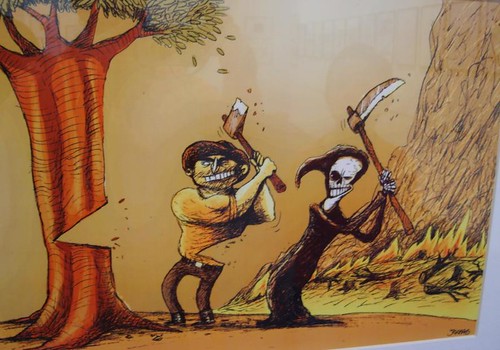
Through John Robinson’s text “Sustainability” the ecological imperative can be defined as the imperative “to stay within the biophysical carrying capacity of our planet.” Other words, to keep a balance and preserve the different ecosystems on our planet in order to sustain a proper natural balance. As it seems most all ecosystems are linked somewhere, so by destroying one you affect another and the chain moves on. Deforestation is becoming an important ecological issue to our world. Forests are responsible for converting a major part of carbon-dioxide in the air into oxygen. It inhabits millions of species of animals and plants but is know being cleared for farming or construction in South America or being cut to make toothpicks for luxurious Japanese dinners as Benjamin Barber says it. Development is progressing at the expense of forests, which could in the future have serious ecological effects on our world, animals and temperature.
Thursday, September 25, 2008
Ecological Imperative: GLOBAL WARMING

Barber in his paper “Jihad vs. McWorld” talked about four imperatives when speaking of the McWorld. Between these four, he mentioned an ecological imperative. When discussing in class about the paper, we said that global warming was an example of an ecological imperative.
An ecological imperative would be for the McWorld a consequence touching the whole globe inexorably. In the paper, Barber gave some examples to illustrate this like the planet possibly being asphyxiated because the Brazilians are cutting trees in the tropical forest in order to get land for growing crops. So how is global warming relevant as an example of ecological imperative?
The issue with global warming is that it is menacing the whole planet and not just a part of the earth. The whole planet is getting hotter. To me there is not even more relevant example as this one because everywhere on the planet if you attempt for example to the ozone layer, the consequences would be worldwide. Therefore, because factories all over the world pollute the air and alter the ozone layer, the ices are melting at both hemispheres. As a matter of facts in both expressions “globalization” and “global warming” there is the same idea of something global which means that it is occurring everywhere.
An ecological imperative would be for the McWorld a consequence touching the whole globe inexorably. In the paper, Barber gave some examples to illustrate this like the planet possibly being asphyxiated because the Brazilians are cutting trees in the tropical forest in order to get land for growing crops. So how is global warming relevant as an example of ecological imperative?
The issue with global warming is that it is menacing the whole planet and not just a part of the earth. The whole planet is getting hotter. To me there is not even more relevant example as this one because everywhere on the planet if you attempt for example to the ozone layer, the consequences would be worldwide. Therefore, because factories all over the world pollute the air and alter the ozone layer, the ices are melting at both hemispheres. As a matter of facts in both expressions “globalization” and “global warming” there is the same idea of something global which means that it is occurring everywhere.
Wednesday, September 24, 2008
Globalisation: Jihad and McWorld
Benjamin Barber explains the occurrence of two contradictory phenomena. He names them “Jihad” and “McWorld”. He explains “McWorld” like globalization we understand today with “a market imperative, a resource imperative, an information-technology imperative, and an ecological imperative” but beyond simple interpretation, it describes a moving away from democracy. Barber claims “McWorld” promises a lot (as for globalization), however “at the cost of independence, community and identity.” To the correct running of “Mcworld”, is needed freedom, tranquility and a no war state. The author sites Saddam Hussein as in example, explaining, if not for thriving war with neighboring countries, no intervention would have been likely on the bases of his many crimes. Through Barber, McWorld is thriving for peasable undisturbed economic activity at the expense of other values. Governments are also omitting certain powers to international institutions in which Barber explains “International law ceases to be vision of justice and becomes a workday framework.”
“Jihad” expresses a strong will for nationalism. “More than thirty wars in progress last year, most of them ethnic, racial, tribal, or religious in character” explained Benjamin Barber. He furthers his argument with Soviet Georgia haven gained independence and now facing demands of independence by Ossetians and Abkhasians (minorities in the state). These claims hold true when observing the many ethnic and religious conflicts that have arisen this past decade. It is possible that in the midst of being open to and now connected to the millions across the world, individuals search for their own identity and belonging and attempt to figure out what is right amongst all the bads that flow through nations. Maybe as a reaction to the visible negative aspects of globalization, groups feel a need to isolate and regroup themselves for their own benefit. Some say the problems are deep rooted and have just been surfacing more these past years. It visibly clear that “Jihad” is happening but I am not completely convinced that it is in big part due to globalization or to be associated to globalization. I believe it has been mediated more now a days, but has been around since and just plainly reflects certain people’s true wants without needing to go into globalization.
I do not agree however to the claim that democracy and globalization cannot move together. I think people and governments are realizing even more now the drawbacks to globalization and are securing for safer advance towards further advancement. Each country and government searches for their own interest in globalization, so the final outcome will be whatever the people choose benefits them best. I think most people rather obey and listen to their own government then some foreign institution, so local governments won’t lose power nor agree to give up all authority and control.
“Jihad” expresses a strong will for nationalism. “More than thirty wars in progress last year, most of them ethnic, racial, tribal, or religious in character” explained Benjamin Barber. He furthers his argument with Soviet Georgia haven gained independence and now facing demands of independence by Ossetians and Abkhasians (minorities in the state). These claims hold true when observing the many ethnic and religious conflicts that have arisen this past decade. It is possible that in the midst of being open to and now connected to the millions across the world, individuals search for their own identity and belonging and attempt to figure out what is right amongst all the bads that flow through nations. Maybe as a reaction to the visible negative aspects of globalization, groups feel a need to isolate and regroup themselves for their own benefit. Some say the problems are deep rooted and have just been surfacing more these past years. It visibly clear that “Jihad” is happening but I am not completely convinced that it is in big part due to globalization or to be associated to globalization. I believe it has been mediated more now a days, but has been around since and just plainly reflects certain people’s true wants without needing to go into globalization.
I do not agree however to the claim that democracy and globalization cannot move together. I think people and governments are realizing even more now the drawbacks to globalization and are securing for safer advance towards further advancement. Each country and government searches for their own interest in globalization, so the final outcome will be whatever the people choose benefits them best. I think most people rather obey and listen to their own government then some foreign institution, so local governments won’t lose power nor agree to give up all authority and control.
Jihad vs. Mcworld
The « Jihad vs. Mcworld » paper describes two tendencies occurring currently and going against each other. On one hand, we have the Jihad which is defined as the whole of conflicts of ethnicities, religion or the problem of nationalism that divide the world. On the other hand, we have the Mcworld which is the flow of information, people and capitals in another word, the system of connection existing between countries and reducing boundaries. Then, it is said in the paper that neither Jihad nor Mcworld is promoting democracy and that democracy wouldn’t survive with them.
After reading the paper, I found it very sensible when it comes to define the two tendencies. As a matter of facts, with new technologies that allow us to communicate all over the world to trade online, food travelling everywhere and computers, the Mcworld is very visible. Also when the paper talks about Jihad, I agree with it because by following world’s event you hear a lot about civil wars, religious conflicts and also conflicts of ethnicities. And it is obvious that the two of them are contradictory when one is trying to unify the world and the second one to divide it.
However, when it comes to say that both tendencies Jihad and Mcworld do not need democracy and do not promote it I remain a little bit skeptical. I might not have got it but I think that democracy can survive with the Mcworld. Let us first define democracy. Wikipedia defines it as a form of government in which the supreme power is held completely by the people under a free electoral system. I think that although people with the Mcworld will care a lot about their business and the markets, they will still need to live in a society where their rights are respected and where they have a freedom of decision. However with the Jihad I do believe in democracy no longer because I think that there is no democracy in a place where there is war. To me war imposes its own system of regulation and therefore, we cannot speak of democracy anymore.
After reading the paper, I found it very sensible when it comes to define the two tendencies. As a matter of facts, with new technologies that allow us to communicate all over the world to trade online, food travelling everywhere and computers, the Mcworld is very visible. Also when the paper talks about Jihad, I agree with it because by following world’s event you hear a lot about civil wars, religious conflicts and also conflicts of ethnicities. And it is obvious that the two of them are contradictory when one is trying to unify the world and the second one to divide it.
However, when it comes to say that both tendencies Jihad and Mcworld do not need democracy and do not promote it I remain a little bit skeptical. I might not have got it but I think that democracy can survive with the Mcworld. Let us first define democracy. Wikipedia defines it as a form of government in which the supreme power is held completely by the people under a free electoral system. I think that although people with the Mcworld will care a lot about their business and the markets, they will still need to live in a society where their rights are respected and where they have a freedom of decision. However with the Jihad I do believe in democracy no longer because I think that there is no democracy in a place where there is war. To me war imposes its own system of regulation and therefore, we cannot speak of democracy anymore.
Tuesday, September 23, 2008

Part 1 : Response Assigned readings 1/2 (Cooper Fred)
Cooper Fred makes an analysis of globalization through significant events of the past decades. He explores often avoided topics/sides to globalization. In his work he looks into three principal historic events, that of the slave trade, colonization and the current diamond trade going on in war torn areas Sierra Leone and Angola.
Slave trade as an example of globalization? Some feel globalization should be centered on today’s happenings only or a clear separation between past and present globalization should be established. Which ever, let us first study the case of the slave trade.
The slave trade to begin was a clear exchange between peoples and regions. In Africa it brought western technology, weapons and ideas. In the Americas it brought labor and new people which supplied the sugar industry and to Europe it brought sugar, which is not native to the continent nor can be grown there. So as it seems there should be no reason to not include the slave trade when talking about globalization, what it is and it’s history. Looking closer into the picture, a race of people were enslaved, forcefully relocated, placed into forced labor and their rights taken away.
Slave trade as an example of globalization? Some feel globalization should be centered on today’s happenings only or a clear separation between past and present globalization should be established. Which ever, let us first study the case of the slave trade.
The slave trade to begin was a clear exchange between peoples and regions. In Africa it brought western technology, weapons and ideas. In the Americas it brought labor and new people which supplied the sugar industry and to Europe it brought sugar, which is not native to the continent nor can be grown there. So as it seems there should be no reason to not include the slave trade when talking about globalization, what it is and it’s history. Looking closer into the picture, a race of people were enslaved, forcefully relocated, placed into forced labor and their rights taken away.
Monday, September 22, 2008
Africa in Globalization
Frederick Cooper is dealing with the Globalization from the eye of an African historian. For him in the term globalization, we must notice two ideas. The first one is the idea of “global” and the second, of “ization”. His point is that the “global” evokes the flows of information, capitals, commodities, while the “ization” indicates an on-going process meaning that globalization is a continuing phenomena. Therefore, speaking of an on-going process, we should first make a rappel on the history of Africa in globalization. This is why he mentions farther in his document the slavery trade, the colonization and the history of sugar, trying to find a connection with the globalization.
As a matter of facts, under all these, there was a structure, a connection, all a system established between nation-states to operate well. This was already a kind of globalization where Africa took part. Today, Africa no more has the same connection with the rest of the world. In fact, Frederick Cooper’s point is how connections change between nation-states and continents. Studying the role of Africa in the process of globalization, how are made the connections between continents and which are they, which are the limits and their changes are the matters of globalization.
As a matter of facts, under all these, there was a structure, a connection, all a system established between nation-states to operate well. This was already a kind of globalization where Africa took part. Today, Africa no more has the same connection with the rest of the world. In fact, Frederick Cooper’s point is how connections change between nation-states and continents. Studying the role of Africa in the process of globalization, how are made the connections between continents and which are they, which are the limits and their changes are the matters of globalization.
Thursday, September 18, 2008
What is globalization

Globalization was defined on Wikipedia as "the process or transformation of local or regional phenomena into global ones."
Subscribe to:
Posts (Atom)